
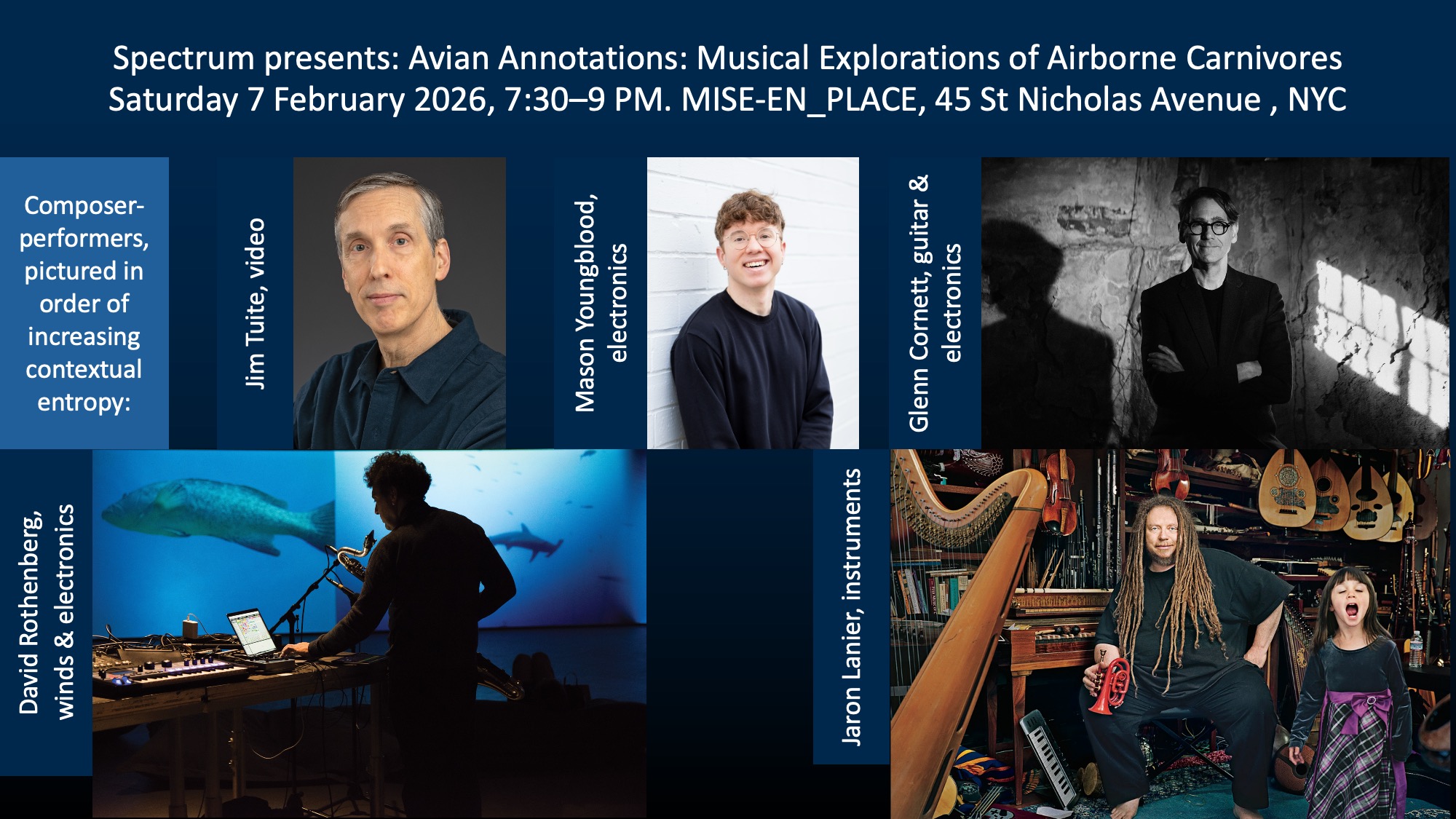
Spectrum and MISE-EN_PLACE are thrilled to present a series of new compositions on birds that tend to inhabit Beijing, and a specific species of tree inhabited by those birds. Think of this as an effort to rise beyond (or otherwise disengage from) differences of ideology, trade policy, and so forth. We recognize and celebrate the importance (and indeed, wonder) of individuals, whether they be human or avian.
Some of the most-accomplished bird-music composers in the nation (this is actually true) will be on hand to present premieres.
Admission is $20 general, $10 students & seniors.
Musician and philosopher David Rothenberg wrote Why Birds Sing, Bug Music, Survival of the Beautiful and many other books, published in at least eleven languages. He has more than forty recordings out, including One Dark Night I Left My Silent House which came out on ECM, and more recently Just Leave It All Behind and Lost Steps. He has performed or recorded with Pauline Oliveros, Peter Gabriel, Ray Phiri, Suzanne Vega, Scanner, Elliott Sharp, Umru, Iva Bittová, and the Karnataka College of Percussion. In 2024 he won a Grammy Award as part of For the Birds, in the category of Best Boxed Set. Whale Music and Secret Sounds of Pondsare his latest books. Nightingales In Berlinand Eastern Anthems are his latest films. His piece Eleven Paths to Animal Musicpremiered at the Sammlung Hoffmann in Berlin in 2025. Rothenberg is Distinguished Professor at the New Jersey Institute of Technology.
Mason Youngblood is a behavioral scientist and sound artist at Stony Brook University’s Institute for Advanced Computational Science, where he investigates the cultural evolution of communication, cognition, and creativity in both human and non-human animals. His recent research—published in journals like Science and featured by National Geographic and Scientific American—uses computational modeling to reveal the structural complexity and cultural richness of bird and whale songs. Drawing on over a decade of experience in electronic music production and DJing, Youngblood merges generative composition with scientific data to create immersive audio installations. His current work reconstructs the lost voices of endangered and extinct species, inviting audiences to inhabit non-human perspectives and experience the disappearing cultural traditions of the more-than-human world.
Jim Tuite is an artist working in video, drawing and photography. He holds an MFA degree from School of Visual Arts and BFA degree from Tyler School of Art. He has performed live visuals for various musical acts and venues in the NY, NJ, Philadelphia, Washington DC vicinity and others with an emphasis on metaphor and association. His projections utilize original and frequently modified video clips, video synthesis, 3D models with processing and found archival film footage. The visuals he creates feature the use of audio analysis and beat detection and various video effects that reflect the feel of the music.
He has performed at the Ab Uno Pluribus series, the Experimental Music Festivals 3-7, the eeeem festivals, NEEMFest 2023, 2024 and SVA Alumni festivals. He has done live visuals for the long running series called Ambient Chaos and the Modular Synth series. His portfolio of drawings appeared in Furious Pure in 2024.
Jaron Lanier has been on the cusp of technological innovation from its infancy to the present. A pioneer in virtual reality (a term he coined), Lanier founded VPL Research, the first company to sell VR products, and led teams originating VR applications for medicine, design, and numerous other fields. He is currently the “octopus” (which stands for Office of the Chief Technology Officer Prime Unifying Scientist) at Microsoft. He was a founder or principal of startups that were acquired by Google, Adobe, Oracle, and Pfizer.
In 2018, Lanier was named one of the 25 most influential people in the previous 25 years of tech history by Wired Magazine. He’s also been named one of the 100 most influential people in the world by Time Magazine. Lanier’s writing appears in The New York Times, Discover, The Wall Street Journal, Forbes, Harpers Magazine, and the Atlantic. Jaron Lanier is also a specialist in unusual and historical musical instruments; he maintains one of the largest and most varied collections of actively played instruments in the world. He has performed or recorded with a wide range of musicians, including Philip Glass, Yoko Ono, Ornette Coleman, George Clinton, T Bone Burnett, Steve Reich, Jon Batiste, Les Claypool, Sean Lennon and Sara Bareilles. Lanier’s first book, You Are Not a Gadget, A Manifesto, is held dear by readers as an expression of spiritual sensibility in a high tech world. It was chosen as one of the best books of the year by Time Magazine and The New York Times.
Glenn Cornett is the founder of Spectrum, an organization whose stated mission is to foster innovation and virtuosity in the arts. Since 2012, Spectrum has functioned mainly as an arts venue (sometimes more as a “venue concept” since the Covid-19 pandemic) in NYC, presenting a variety of arts events, the majority of them involving modernist music (here loosely defined as music composed form 1900 onward). As a composer/performer, Glenn uses guitar, electronics and keyboard, collaborating in a variety of ensemble contexts. For his “day job,” he is a biotech entrepreneur working in neurological and cardiovascular domains (including their intersection).
Glenn holds an MD from the University of Michigan and a neuroscience PhD from UCLA. His dissertation (roughly equal parts systematic musicology, neurophysiology and cognitive science) was on deep-brain responses to musical stimuli. Music training has included synthesizer performance while an undergraduate (“one of the few chemistry majors with a key to the electronic music lab”) and music theory, ethnomusicology and systematic musicology while a graduate student. He has also studied with several composers who will be neither blamed nor incriminated here.